
DMAIC: A practical framework for continuous improvement

Improving a process sounds simple: identify what is not working, fix it, and check whether the change worked.
In practice, improvement projects often become more complicated. Team members can take decisions and consider solutions before and without fully understanding the problem. In these cases, their choices are mainly based on beliefs and guesses bu not on concrete data. And even when an improvement works, the old problems may return a few months later.
DMAIC provides a structured way to avoid these issues.
Originally developed as a core part of Six Sigma, DMAIC is a five-step method used to improve existing processes. DMAIC means: Define, Measure, Analyze, Improve and Control.
Its strength is not complexity. It is discipline. Each phase in the DMAIC methodology answers a question before moving to the next one.

1. Define: Understand what needs to change
The first step is to define the problem clearly.
This may sound obvious, but teams often start improvement projects with a solution already in mind: automate a task, change a supplier, add a control point or introduce new software.
DMAIC starts somewhere else.
What problem are we trying to solve?
Who is affected by it?
What should we improve?
And what is outside the scope of the project?
The Define phase usually includes the project objectives, scope, stakeholders and customer requirements. A high-level process map can also help everyone understand where the issue sits within the wider process.
The goal is to make sure the team is solving the right problem before investing time in solutions.
2. Measure: Understand the current situation
Once the problem is defined, the next step is to measure it.
A process may feel inefficient, unreliable or slow. But improvement requires more than impressions.
The team needs a baseline. Depending on the process, this could include cycle and lead time, defect rate, delays, production yield, customer complaints, energy consumption or other relevant performance indicators.
The process is usually mapped in more detail at this Measure stage. Data is collected and the measurement approach is checked to make sure the results are reliable.
The purpose is simple: understand where the process is today before trying to change it.
Without a baseline, it becomes difficult to demonstrate later whether an improvement worked.
3. Analyze: Find the root causes
Knowing that a problem exists is not the same as knowing why it exists.
The Analyze phase focuses on identifying the causes behind the observed performance.
This is where the team compares current performance with the expected result, looks for patterns in the data and investigates potential root causes.
Several tools can support this work, depending on the problem. These may include process analysis, Pareto analysis, cause-and-effect diagrams, statistical analysis or the Five Whys.
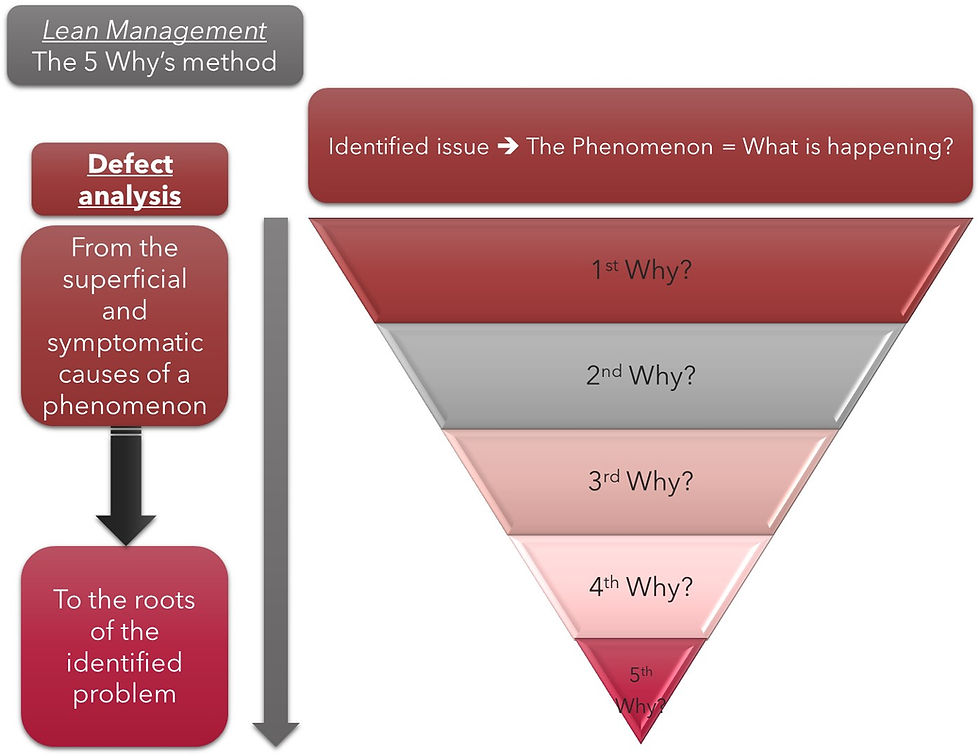
But the tool is secondary. The main objective is to separate symptoms from causes.
For example, repeated production delays may initially appear to be a capacity problem. Analysis may show instead that most delays come from one validation step, incomplete information received upstream or large variations between batches.
DMAIC encourages teams to validate these causes with evidence before moving to solutions.
4. Improve: Test solutions that address the causes
Only after the main causes are understood does the team move to improvement.
In this Improve phase, the goal is to find solutions that address the causes established during the Analyze phase and not to produce as many ideas as possible.
Possible solutions are compared, tested and refined during the Improve phase.
Where possible, teams can use pilots before implementing a change across the whole process. This reduces risk and provides evidence on whether the proposed solution delivers the expected result.
The future process can then be mapped and compared with the initial situation.
And once again, data matters. An improvement should not only look better on paper. Its effect should be measurable.
5. Control: Make the improvement last
One of the most important parts of DMAIC is also one of the easiest to overlook.
After an improvement has been implemented, the work is not finished.
Processes change. Teams change. Priorities change. And without monitoring, organizations can gradually return to their previous way of working.
The Control phase focuses on maintaining the improvement.
This can include defining performance indicators, introducing monitoring or control plans, documenting the new process and training the people involved.
The team also needs to know what to do if performance starts moving in the wrong direction again.
The objective is not simply to fix a process once, but to keep it under control over time.
Where Six Sigma fits
DMAIC is closely associated with Six Sigma, a methodology focused on reducing defects and process variation.
Six Sigma relies strongly on measurement and data analysis. The principle is that process performance can be improved by understanding the sources of variation and systematically reducing them.
DMAIC provides the structure for doing this. But the framework is not limited to large Six Sigma activity sectors such as manufacturing, large industries, and administrative domains. DMAIC approach can be also considered in quality management, projects management, clients service, Research / Development / Innovation activities, supply chains running, etc.
The level of statistical analysis depends on the problem being addressed.
Where Kaizen fits
Kaizen takes a slightly different approach.
The term is commonly translated as continuous improvement or change for better. Instead of focusing only on major transformation projects, Kaizen encourages teams to make regular, incremental improvements to the way they work.
DMAIC and Kaizen complement each other well.
A DMAIC project can provide the structure needed to address a specific performance problem. Kaizen can help teams continue improving the process after the main project is completed.
Kaizen events can also be used during the Improve phase. A team may work intensively for a short period to redesign part of a process, test ideas and implement practical changes.
The Control phase then creates a natural connection with continuous improvement. Once the new process is stable, teams continue monitoring it and identifying further opportunities for improvement.
Why DMAIC remains useful
DMAIC is because it creates a sequence.
Define before measuring.
Measure before analyzing.
Analyze before improving.
And control before moving on.
This reduces the temptation to jump straight from a problem to a solution.
It also creates several practical benefits.
The process becomes more data-driven, because decisions are based on evidence rather than assumptions.
It remains customer-focused, because the initial objectives and requirements are defined around the people who use or depend on the process.
And it supports continuous improvement, because the final step is not simply implementation, but long-term monitoring and learning.
A simple framework, but not a shortcut
DMAIC does not guarantee that every improvement project will succeed.
Poor data can still lead to wrong conclusions. Teams can still select weak solutions. And process changes will not last if the people involved do not adopt them.
But the framework gives teams a clear way to structure the work. It forces them to understand the problem before trying to solve it.
Combined with the analytical approach of Six Sigma and the continuous improvement mindset of Kaizen, DMAIC can help organizations make process improvement more systematic, measurable and sustainable.
And in many cases, that discipline matters more than the complexity of the tools being used.
Want to learn more?
At NETO Innovation, we regularly share practical insights on innovation, process improvement, R&D, European funding and project development.



Comments