
Greening buildings: more than adding plants to roofs and façades

Cities need more vegetation. But in dense urban areas, finding space for it is not always easy.
Roofs, façades, balconies and other parts of buildings offer an alternative. Instead of treating vegetation as something that only belongs at ground level, buildings themselves can become part of the urban green infrastructure.
This idea is not new. Green roofs and vegetated façades have been studied for decades. Research shows that they can contribute to cooling, stormwater management and building performance. But it also shows something important: simply adding plants to a building does not automatically deliver these benefits.
Performance depends on how vegetation, water, the building envelope and the local climate work together.

Turning unused surfaces into green infrastructure
Dense cities contain large areas of roofs and façades that perform a limited number of functions. A roof protects the building. A façade separates indoor and outdoor environments.
Vegetation can add other functions to these surfaces.
Green roofs can retain part of the rainfall that would otherwise flow directly into drainage systems. Water stored in the substrate or drainage layers can later return to the atmosphere through evaporation and plant transpiration. Research comparing different systems has shown that their capacity for cooling and water retention can vary considerably depending on their design [1,2].
Vegetation can also change the thermal behavior of the building itself. In a monitored project in Toronto, extensive green roofs reduced heat transfer through the roof during summer and delayed and reduced stormwater runoff [3].
The same principle can extend beyond roofs. Vegetated façades can provide shade while evapotranspiration contributes to cooling. Research in Berlin has explored the connection between façade greening, rainwater management and building cooling for more than two decades [4].
This creates an interesting shift in how we think about buildings. A building surface does not necessarily have to perform one function. It can become part of the city's water, energy and ecological systems at the same time.
Plants can help cool buildings, but water matters
One of the most studied effects of building greening is cooling.
Plants shade surfaces from direct solar radiation. But an equally important mechanism is evapotranspiration. Water evaporating from the substrate and passing through plants uses energy that would otherwise contribute to heating the surrounding environment.
This can produce substantial differences on the surface of a building. In one study under continental climate conditions, researchers measured differences of up to 24°C between the temporary surface temperature of an extensive green roof and a conventional roof during summer [5].
But there is an important condition: plants need access to water.
A dry green roof cannot provide the same evaporative cooling as a well-watered one. Research comparing different green-roof systems in Germany found that solar radiation, relative humidity and water availability were among the main factors controlling evapotranspiration. The system with permanent water storage maintained higher substrate moisture and reached higher peak evapotranspiration [1].
Research in Amsterdam reached a similar conclusion. Conventional shallow green roofs dried relatively quickly during hot periods, limiting evaporation and cooling. Systems combining water storage and capillary irrigation maintained water availability for longer and increased evaporation [6].
So the question is not simply how much vegetation can we put on a building? It is also how do we manage the water that vegetation needs?
Rainwater can become a resource
This connection between vegetation and water opens another possibility.
Instead of draining rainfall away from a building as quickly as possible, part of it can be retained and reused.
Green roofs already perform this function to some extent. Rainwater enters the substrate, where part of it is stored and later evaporated or used by plants. Excess water can also be temporarily retained in drainage or storage layers, delaying its release into the sewer network [1,3].
More integrated systems can go further by combining rainwater storage and irrigation.
The principle is simple: collect water when it is available and make it available to vegetation when conditions become dry. This can reduce the need to use drinking water for irrigation while helping vegetation maintain its cooling function during hot periods.
This is particularly relevant because the periods when cooling is most valuable can also be the periods when water is least available. Building greening then becomes partly a water-management problem.
Not every green roof performs in the same way
There is also no single model for a green building.
A shallow extensive roof planted with drought-resistant species behaves differently from a deeper roof with grasses and herbs. A façade covered with climbing plants behaves differently from a modular living wall. And systems with water storage behave differently from systems relying mainly on rainfall.
Even within green roofs, performance depends on several parameters: substrate depth and composition, vegetation type, drainage layers, water-storage capacity, irrigation strategy and local climate.
Research comparing different vegetation structures has shown that the quantity and structure of plant biomass can significantly affect passive cooling. Different vegetation types can produce different temperature profiles even when installed on the same roof [7].
Shallow substrates also have a limited capacity to retain water and can dry out more quickly during long dry periods. Plant characteristics, substrate properties, rainfall patterns, solar radiation, humidity and wind can all influence thermal behavior [5].
This matters when moving from small experiments to real buildings. A solution that performs well in one climate or on one type of building cannot simply be copied elsewhere with the expectation of obtaining the same results.
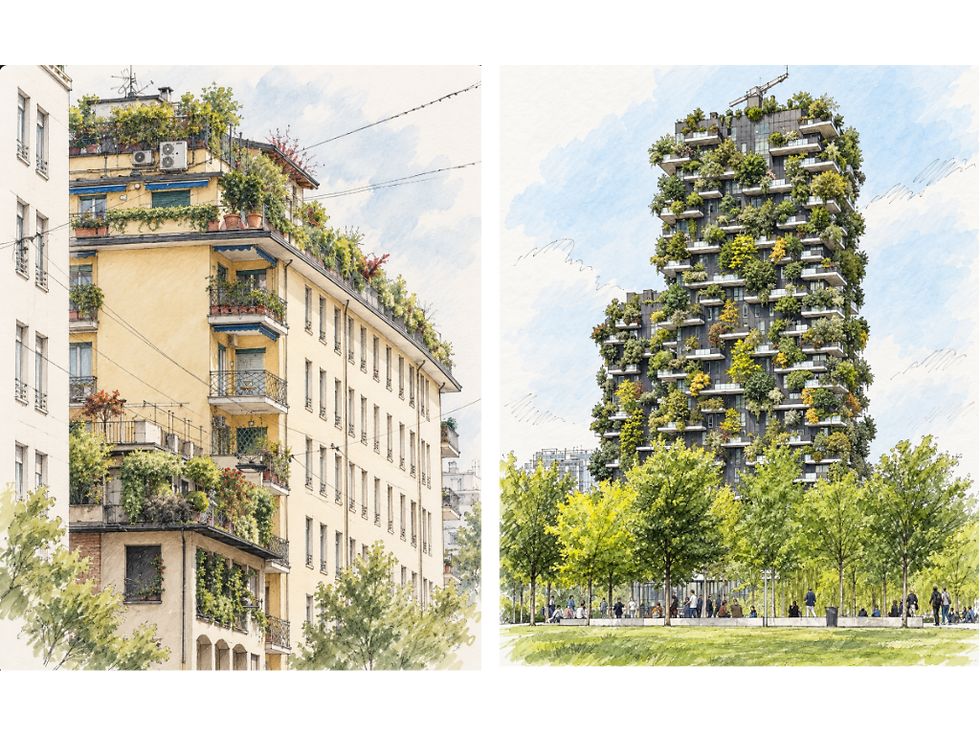
From individual buildings to the urban microclimate
The next question is whether building greening can influence conditions beyond the building itself. Research suggests that it can, particularly when vegetation is deployed at larger scale.
A modelling study covering different residential neighbourhoods in Hong Kong found that widespread green-roof installation reduced pedestrian-level air temperatures. The magnitude of the effect varied according to vegetation type and urban form: building height, density and the circulation of air all influenced how far the cooling effect travelled [8].
This is an important distinction. A green surface can lower its own temperature substantially without producing the same reduction in neighbourhood air temperature. Urban cooling depends on scale, building geometry, wind, humidity, vegetation and many other factors.
Building greening should not be presented as a universal solution to the urban heat-island effect. It is one component of a broader adaptation strategy that can include trees, parks, permeable surfaces, shading, water management and changes to building materials.
Biodiversity needs to be designed, not assumed
Greening buildings also creates opportunities for urban biodiversity. Roofs and façades can provide vegetation in places where conventional green space is difficult to create. They can potentially contribute to networks of habitats across dense urban areas.
But a green surface is not automatically a biodiverse one. Plant diversity, flowering periods, vegetation structure, substrate conditions and maintenance practices all influence which species can use these spaces. Designing for biodiversity requires a different approach from simply maximising plant coverage.
The objective may also vary from one building to another. In some locations, the priority may be pollinators. Elsewhere, it may be native plant diversity, habitat connectivity or vegetation resilience under heat and drought.
This is why plant selection should be treated as an engineering and ecological design decision rather than as a final landscaping choice.
The building still comes first
There are also practical limits. Vegetation adds weight. Water adds more. Substrates, drainage systems and supporting structures require space. Existing buildings may have limited load-bearing capacity. One experimental study in Hong Kong, for example, specifically adjusted substrate depth and system weight to address the structural limitations of an existing roof [7].
Façades introduce other questions: attachment systems, wind loads, fire safety, waterproofing, access for maintenance and the interaction between vegetation and the existing envelope. And every system needs to survive for years instead of simply looking good when installed. Maintenance, irrigation, plant replacement and access need to be considered from the beginning.
Greening buildings: the integration approach
The most interesting development in building greening may not be a new type of green roof or living wall. It may be the integration of systems that have traditionally been designed separately.
Vegetation can interact with rainwater collection. Water availability affects evapotranspiration and cooling. Shading affects building energy demand. Plant selection affects biodiversity. Structural design determines what can be installed. Sensors and modelling can then help measure how these interactions perform over time. This changes the design question. Instead of asking: “Where can we add plants to this building?” we can ask: “How can the building use vegetation, water and its available surfaces to improve its environmental performance?”
That is a much more demanding question. It requires architects, engineers, ecologists, building physicists, water specialists and building owners to work together.
But it also reflects what the research increasingly shows: the benefits of building greening do not come from vegetation alone. They come from designing the building, vegetation and water as parts of the same system.
Interested in sustainable buildings and European R&I?
At NETO Innovation, we work with research organisations, companies and other innovation actors developing collaborative European projects in areas including sustainable construction, climate adaptation, materials, energy and environmental technologies.
Visit our website to discover our activities, follow us on LinkedIn for our latest updates, and subscribe to our newsletter to receive news on EU funding opportunities, innovation and ongoing projects.
And if you are developing an idea for a Horizon Europe or other EU-funded project and are looking for support with consortium building, proposal development, project management, communication, exploitation or sustainability activities, feel free to contact us. We are always interested in discussing new European R&I collaborations.
References
Gößner, D., Mohri, M. & Krespach, J.J. (2021). Evapotranspiration measurements and assessment of driving factors: A comparison of different green roof systems during summer in Germany. Land, 10, 1334. https://doi.org/10.3390/land10121334
European Federation of Green Roof and Wall Associations (EFB), Bundesverband GebäudeGrün (BuGG) & GRÜNSTATTGRAU (2025). Benefits of green buildings: Green roofs, green walls and vertical indoor greenery – A compilation of numbers, data and facts from different investigations.
Liu, K. & Minor, J. (2005). Performance evaluation of an extensive green roof. National Research Council Canada / City of Toronto, NRCC-48204. Presented at Greening Rooftops for Sustainable Communities, Washington, D.C.
Schmidt, M. (2003). Energy saving strategies through the greening of buildings: The example of the Institute of Physics of the Humboldt-University in Berlin-Adlershof. RIO 3 – World Climate & Energy Event, Rio de Janeiro.
Baryła, A., Gnatowski, T., Karczmarczyk, A. & Szatyłowicz, J. (2019). Changes in temperature and moisture content of an extensive-type green roof. Sustainability, 11, 2498. https://doi.org/10.3390/su11092498
Cirkel, D.G., Voortman, B.R., van Veen, T. & Bartholomeus, R.P. (2018). Evaporation from (blue-)green roofs: Assessing the benefits of a storage and capillary irrigation system based on measurements and modeling. Water, 10, 1253. https://doi.org/10.3390/w10091253
Jim, C.Y. (2012). Effect of vegetation biomass structure on thermal performance of tropical green roof. Landscape and Ecological Engineering, 8, 173–187. https://doi.org/10.1007/s11355-011-0161-4
Peng, L.L.H. & Jim, C.Y. (2013). Green-roof effects on neighborhood microclimate and human thermal sensation. Energies, 6, 598–618. https://doi.org/10.3390/en6020598
Takebayashi, H. & Moriyama, M. (2007). Surface heat budget on green roof and high reflection roof for mitigation of urban heat island. Building and Environment, 42(8), 2971–2979.
Al-Kodmany, K. (2023). Greenery-covered tall buildings: A review. Buildings, 13, 2362. https://doi.org/10.3390/buildings13092362


Comments