
Innovative advanced materials: What the European Commission’s Scientific Opinion means for Europe’s future

Advanced materials are becoming one of the most important building blocks of Europe’s future economy.
They are found in batteries, semiconductors, medical devices, renewable energy systems, aerospace technologies and advanced manufacturing. They help make products lighter, stronger, safer and more efficient. They also play a critical role in reducing dependence on scarce resources and supporting the transition to a low-carbon economy.
For years, advanced materials were mainly discussed within scientific and industrial circles. Today, they have become a strategic policy priority.
In April 2026, the European Commission’s Scientific Advice Mechanism (SAM) published its Scientific Opinion on Advanced Materials. Prepared by the Group of Chief Scientific Advisors and supported by evidence gathered through the SAPEA network, the report provides independent scientific recommendations to support future European policy in this area. The publication comes at a crucial moment as the European Commission prepares the future Advanced Materials Act, a legislative initiative designed to strengthen Europe’s ability to develop, manufacture and deploy advanced materials across key industrial sectors.
The message from the advisors is straightforward. Advanced materials are no longer just a research topic. They are becoming a strategic asset for Europe’s competitiveness, resilience and long-term prosperity.

The report argues that Europe should build its future strategy around four key principles: autonomy, safety, sustainability and prosperity. According to the advisors, these values can become a competitive advantage and help Europe create a stronger and more resilient industrial ecosystem.
As global competition intensifies and supply chains become more vulnerable, the ability to design, produce and deploy advanced materials is increasingly linked to economic security and technological leadership.
The question is no longer whether advanced materials matter. The question is whether Europe can transform its scientific strengths into industrial leadership.
Why innovative advanced materials matter
The Organisation for Economic Co-operation and Development (OECD) defines advanced materials as materials designed to have new or enhanced properties that deliver improved functional performance.
This definition covers a broad range of technologies and applications. Advanced materials include biomaterials used in healthcare, lightweight composites used in transport, advanced ceramics for industrial applications, nanomaterials for electronics, and quantum materials for next-generation computing.
What makes these materials different is their ability to solve challenges that conventional materials cannot address.
Some improve energy efficiency.
Some replace scarce or hazardous substances.
Others enable entirely new technologies.
Their applications are already visible across Europe’s economy. Advanced materials are used in renewable energy infrastructure, medical devices, aircraft components, electric vehicles, construction materials and advanced electronic systems.
According to the Scientific Opinion, advanced materials are essential for achieving several European objectives simultaneously.
They can support the green transition, accelerate digitalisation, strengthen industrial competitiveness, improve resilience and reduce dependence on critical raw materials.
This is why advanced materials have moved from being a scientific opportunity to becoming a strategic necessity.
The growing importance of strategic autonomy
Europe’s interest in advanced materials is closely linked to the concept of strategic autonomy.
Over the past decade, several events have exposed vulnerabilities in global supply chains. The COVID-19 pandemic disrupted manufacturing and logistics networks. And, geopolitical tensions have increased competition for critical technologies and raw materials.
These developments have forced policymakers to reconsider how Europe secures access to key technologies and industrial capabilities. Advanced materials are now viewed as part of the solution.
By developing materials that reduce reliance on imported resources, improve recycling capabilities and enable alternative technologies, Europe can strengthen its resilience and reduce strategic dependencies.
This explains why advanced materials now feature prominently in several major European initiatives, including the European Green Deal, the Critical Raw Materials Act, the Chips Act, the Clean Industrial Deal and Horizon Europe.
The future Advanced Materials Act is expected to bring these efforts together within a more coherent framework.
Europe starts from a strong position
One of the key conclusions of the Scientific Opinion is that Europe already possesses significant strengths in advanced materials research.

The continent benefits from world-class universities, leading research infrastructures, internationally recognised standards and strong regulatory expertise. Europe also performs well in scientific databases, digital research tools and sustainability assessment methodologies.
Several research domains stand out.
Biomaterials
Europe has a long history of leadership in biomaterials research. Biomaterials are designed to interact safely with biological systems and are increasingly used in medical applications. They support tissue regeneration, advanced drug delivery systems and next-generation implants. Beyond healthcare, biomaterials are also being explored for soft robotics, biosensors, sustainable packaging and bio-based alternatives to conventional plastics.
The Scientific Opinion identifies biomaterials as one of Europe’s strongest research areas, with significant potential for future innovation. As healthcare systems move toward more personalised treatments, biomaterials are expected to play an increasingly important role.
Composite materials
Composite materials combine different substances to achieve improved performance. In sectors such as aerospace, automotive manufacturing and renewable energy, lightweight composites help reduce weight while maintaining strength and durability. The benefits are significant. Lighter vehicles consume less energy. Aircraft become more fuel-efficient. Wind turbines can be built with improved performance and longer operational lifetimes. Europe remains a global leader in this field.
Advanced ceramics
Ceramics are often associated with traditional products, but advanced ceramics represent a very different category. These materials can operate under extreme temperatures and demanding industrial conditions. They are increasingly used in aerospace, electronics and energy systems. Europe has developed strong expertise in functional ceramics, particularly in areas linked to energy efficiency and advanced manufacturing.
Quantum materials
Quantum materials may underpin the next technological revolution. Their unique electronic and magnetic properties could support future advances in computing, communication and sensing technologies. Europe has developed strong research capabilities in quantum materials, photonics and advanced semiconductors. While industrial deployment remains at an early stage, the long-term potential is considerable.
Why Europe still struggles to scale innovation
Despite these strengths, Europe faces a familiar challenge. Europe is often excellent at generating scientific knowledge but less successful at transforming research into industrial success.
The Scientific Opinion highlights fragmentation as one of the main barriers. Research programmes, funding mechanisms, infrastructures and industrial ecosystems often operate separately. This slows collaboration and makes it more difficult for innovations to move from laboratories to large-scale production.
The problem is not a lack of ideas. The problem is turning ideas into products.
Investors often view advanced materials projects as high-risk because applications and market opportunities are difficult to predict during the early stages of development. As a result, many promising technologies struggle to secure the resources required for scaling.
This challenge is sometimes referred to as the “valley of death” between research and commercialisation. Bridging that gap will require stronger collaboration between researchers, industry, investors and policymakers.
Safety and sustainability must be built into innovation
The Scientific Opinion repeatedly emphasises that Europe should not pursue innovation at any cost. Safety must remain a fundamental requirement. History provides several examples of materials that were initially considered safe but later revealed serious environmental or health risks.
The report cites substances such as Bisphenol A (BPA) and Perfluorooctanoic Acid (PFOA), which were widely used before concerns emerged regarding their long-term impacts.
These experiences demonstrate why safety assessments must be integrated into the innovation process from the beginning. This principle forms the basis of the European Commission’s Safe and Sustainable by Design (SSbD) framework.

The framework encourages researchers and companies to evaluate materials throughout their lifecycle, considering:
Hazard assessment
Human health impacts
Environmental performance
Resource efficiency
Social and economic sustainability
The objective is simple. Develop materials that are not only high-performing but also safe, circular and socially responsible. The advisors argue that this approach can become a distinctive European advantage.
Artificial intelligence is reshaping innovative advanced materials research
The Scientific Opinion also highlights the growing role of artificial intelligence in materials science. Traditionally, discovering and testing new materials has been a slow and expensive process. AI has the potential to accelerate every stage of development. Researchers can use machine learning models to predict material properties, identify promising combinations and optimize designs before physical testing begins.
The report identifies several technologies that could transform the field:
AI-assisted materials discovery
Digital Twins
Self-driving laboratories
Advanced computational modelling
Automated experimentation platforms
These tools could significantly reduce development timelines and improve decision-making.
However, they also depend on access to high-quality data. This is why the Scientific Opinion strongly recommends investing in FAIR data systems that make information Findable, Accessible, Interoperable and Reusable.
Without strong data ecosystems, the full benefits of AI will remain out of reach.
The global race for advanced materials
Europe is not operating in isolation. Other major economies have recognised the strategic importance of advanced materials and are investing heavily.
China has made advanced materials a central component of its industrial strategy. Long-term investments, manufacturing capabilities and state-supported research programmes have enabled the country to become a global leader in several technology areas.
The United States continues to invest through organisations such as DARPA, the National Science Foundation and the Department of Energy. These institutions support both fundamental research and industrial deployment.
South Korea, Japan and India have also expanded their advanced materials strategies in recent years.
This growing international competition creates additional pressure for Europe. Maintaining scientific excellence is no longer enough. The ability to commercialise innovation and build industrial capacity will determine future leadership.
What the Scientific Opinion recommends
The advisors propose four major priorities for future European action.
First, Europe should strengthen data infrastructures and digital capabilities to accelerate research and commercialisation.
Second, policymakers should develop standards and regulatory frameworks that support safety, sustainability and market adoption.
Third, Europe should build stronger innovation ecosystems that connect research institutions, industry, investors and infrastructure providers.
Finally, long-term investment is needed in research, education, critical raw materials and affordable green energy.
Taken together, these recommendations form the basis of a European strategy designed to transform scientific excellence into industrial leadership.
Conclusion
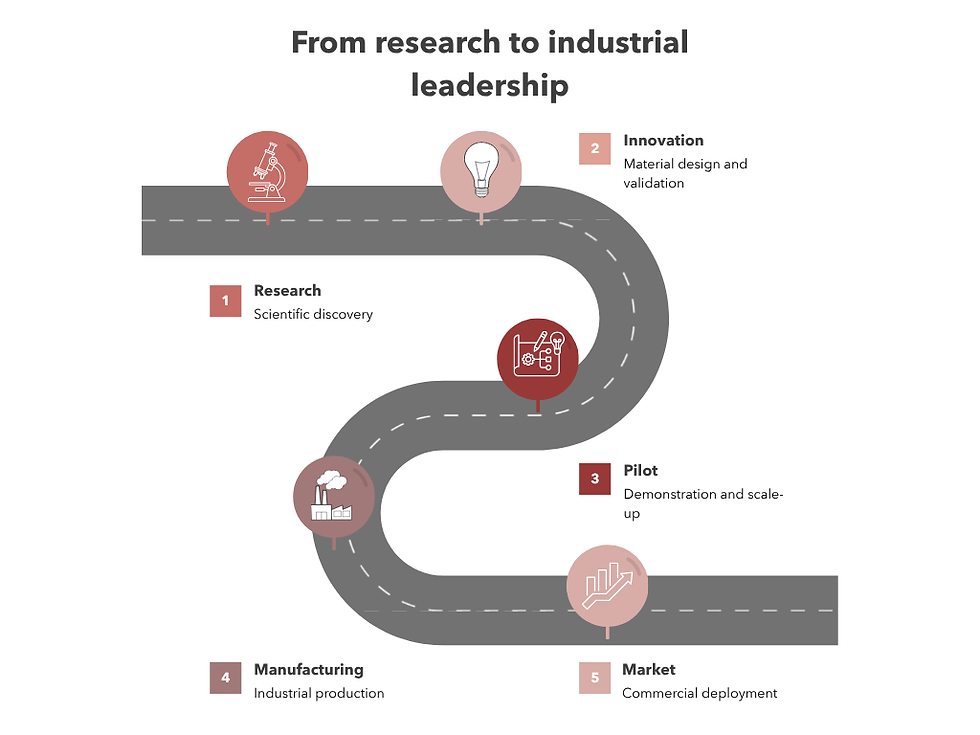
The publication of the Scientific Opinion on Advanced Materials by the Scientific Advice Mechanism marks an important moment for European innovation policy.
It confirms that advanced materials are no longer simply a scientific discipline. They have become a strategic asset.
The technologies developed in this field will influence Europe’s ability to compete globally, achieve climate objectives, strengthen industrial resilience and secure access to critical technologies.
Europe already possesses many of the necessary ingredients: excellent researchers, strong institutions, advanced infrastructures and a clear commitment to sustainability. The challenge now is execution.
If the future Advanced Materials Act succeeds in connecting research, industry, investment and regulation, Europe could position itself as a global leader in safe and sustainable advanced materials.
The opportunity is significant. So is the urgency. The decisions made over the next few years may determine whether Europe remains a technology developer or becomes a technology leader.
How NETO Innovation can help
Advanced materials are becoming a strategic priority across Europe, creating new opportunities for researchers, startups, SMEs and industrial companies. But turning innovative ideas into funded projects requires more than technical expertise. It requires a clear strategy, strong partnerships and a deep understanding of European funding programmes.
At NETO Innovation, we support organisations throughout the entire project lifecycle, from identifying funding opportunities and building consortia to proposal writing, project management and exploitation planning. Whether you are developing next-generation materials, sustainable manufacturing solutions, advanced healthcare technologies or circular economy innovations, our team can help transform your ideas into successful European projects.
If you are preparing a Horizon Europe proposal, or looking to position your organisation within Europe's advanced materials ecosystem, we would be happy to discuss your ambitions.
Contact NETO Innovation to discuss your next project.
Visit our website to discover our services and expertise.
Subscribe to our newsletter to stay informed about European funding opportunities, policy developments and innovation trends.
Follow NETO Innovation on LinkedIn for the latest insights on Horizon Europe, deep tech innovation, advanced materials and EU research and innovation programmes.
The future of advanced materials is being built today. Make sure your organisation is part of it.
Sources:
European Commission Scientific Opinion on Advanced Materials (2026) - https://op.europa.eu/en/publication-detail/-/publication/2f346908-3c9a-11f1-814f-01aa75ed71a1/language-en
Scientific Advice Mechanism – Scoping Paper on Advanced Materials (2025) - https://scientificadvice.eu/advice/advanced-materials/
Summary of the Scientific Opinion on Advanced Materials (2026) - https://op.europa.eu/en/publication-detail/-/publication/7b5dbe97-3c99-11f1-814f-01aa75ed71a1/language-en


Comments